

Does a 5.3% Treasury Matter for Indian Stocks?
A US government bond now pays 5.3%, the most since 2007. The typical large Indian company earns 3.3% on its share price. For the first time since 2023, the safest asset in the world pays more than the earnings yield of Indian large caps.
That is the worry doing the rounds: safe US bonds pay more, so foreign money leaves India and Indian shares fall. It is a tidy story. Before acting on it, we wanted to know whether it is an earned one. So we went back fifteen years of weekly data on Vyāpti, our in-house platform, and asked a simple question: each time US rates jumped, what did Indian stocks, the rupee and foreign money do?
The full research note is attached at the end. Here is what stood out.

Indian earnings yield against the US 10-year, 2011–2026. Page 3 of the research note.
Watch the rupee, not the Treasury
The damage has never come from the yield. It has come from the rupee.
We isolated every episode since 2013 in which the US 10-year rose 60 basis points or more in a quarter. When the rupee held, Indian small caps were up 5% a month later and 25% six months later. When the rupee fell with it, the first month cost 8%. A rupee fall of 4% for any reason, US rates or not, cost the same 8%.
The hit lands in the first four weeks, and it is rupee-led, not rate-led. After that, every path has been positive, though a rupee fall leaves returns below normal for about a year.
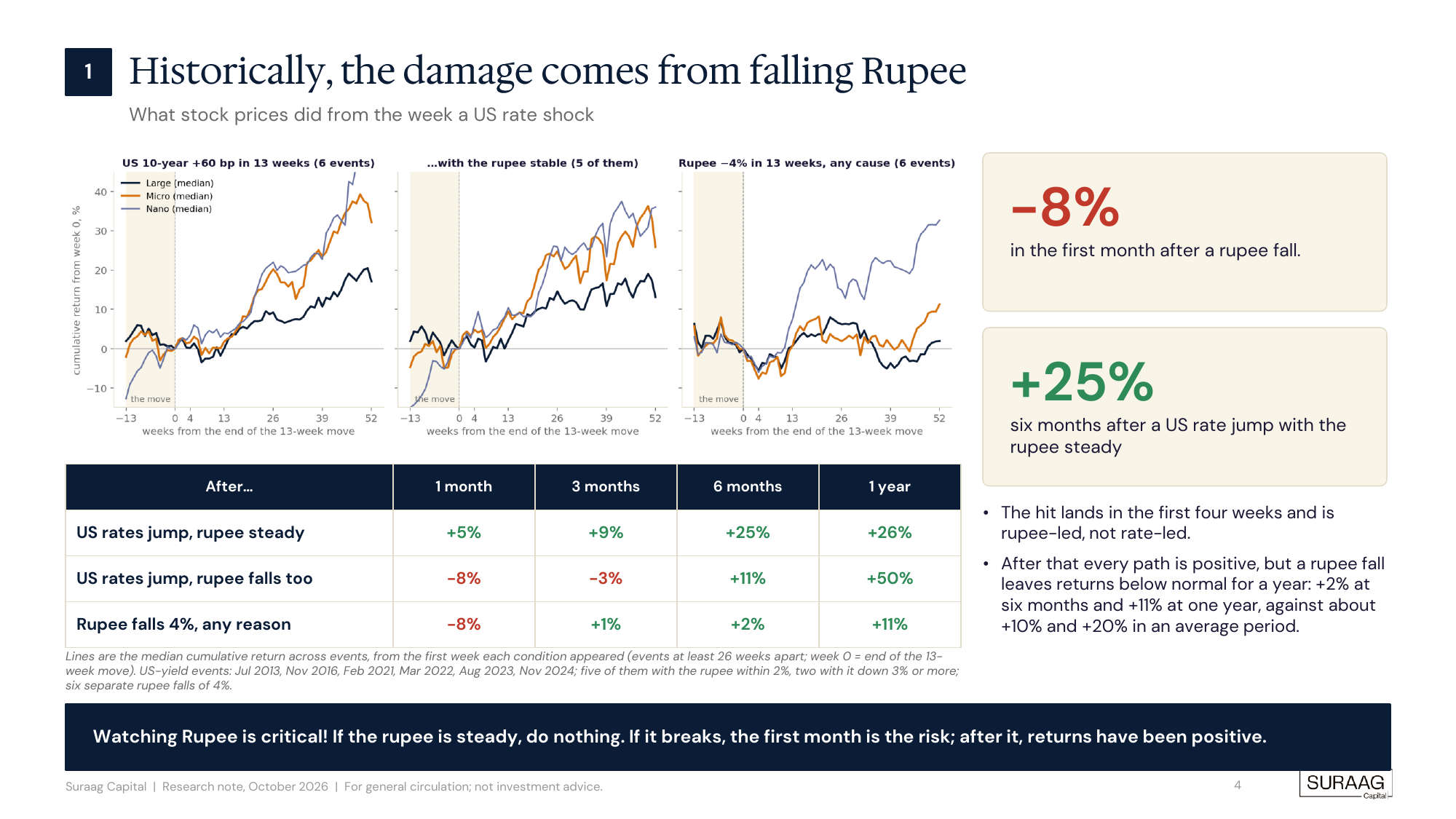
What stocks did after a US rate jump, with and without a rupee fall. Page 4 of the research note.
Every "US rates" scare rose from its low
Six sharp falls since 2013 were blamed on US rates: the taper tantrum, the 2018 oil-and-IL&FS autumn, the 2022 inflation hikes, the "5% scare" of 2023, the dollar surge of late 2024, and the West Asia oil spike this March.
Five of the six came with a falling rupee and heavy foreign selling. The one without a rupee move, October 2023, was barely a dent: large caps fell 5%, small caps 1%.
Neither the size of the rate move nor the size of the rupee move ranked the damage. 2018 was a 0.2-point rise in US yields with a 3.5% rupee fall; 2013 was a 17.8% rupee fall. Both cost about 20%. What the falls share is foreign selling with the rupee weakening.
And each of the six rose from its low. Four regained the pre-fall level inside six months.

The six scares, and the six months after each low. Page 5 of the research note.
Heavy foreign selling has been the buying occasion, with one condition
We sorted all 615 weeks since 2014 by how much foreigners had sold over the previous six months. When selling reached 40 basis points of market value or worse, the average stock was up 15% over the next six months, and up 93% of the time.
The condition is that prices had already fallen. By the time foreigners have sold that much, the average stock is down 7% and the median P/E is down 13%. The price has been paid. The pace of selling then fades: in 93% of those weeks, the next six months' selling was lighter. Foreigners did not need to come back; domestic funds kept buying.
It fails when prices have not fallen first. In January 2022, with the market within 5% of its high, the same signal was followed by a flat six months.
Moderate selling is the poor state, because it tends to get worse before it ends. At 35 basis points on the latest data, that is where we are, a few basis points from the heavy zone.
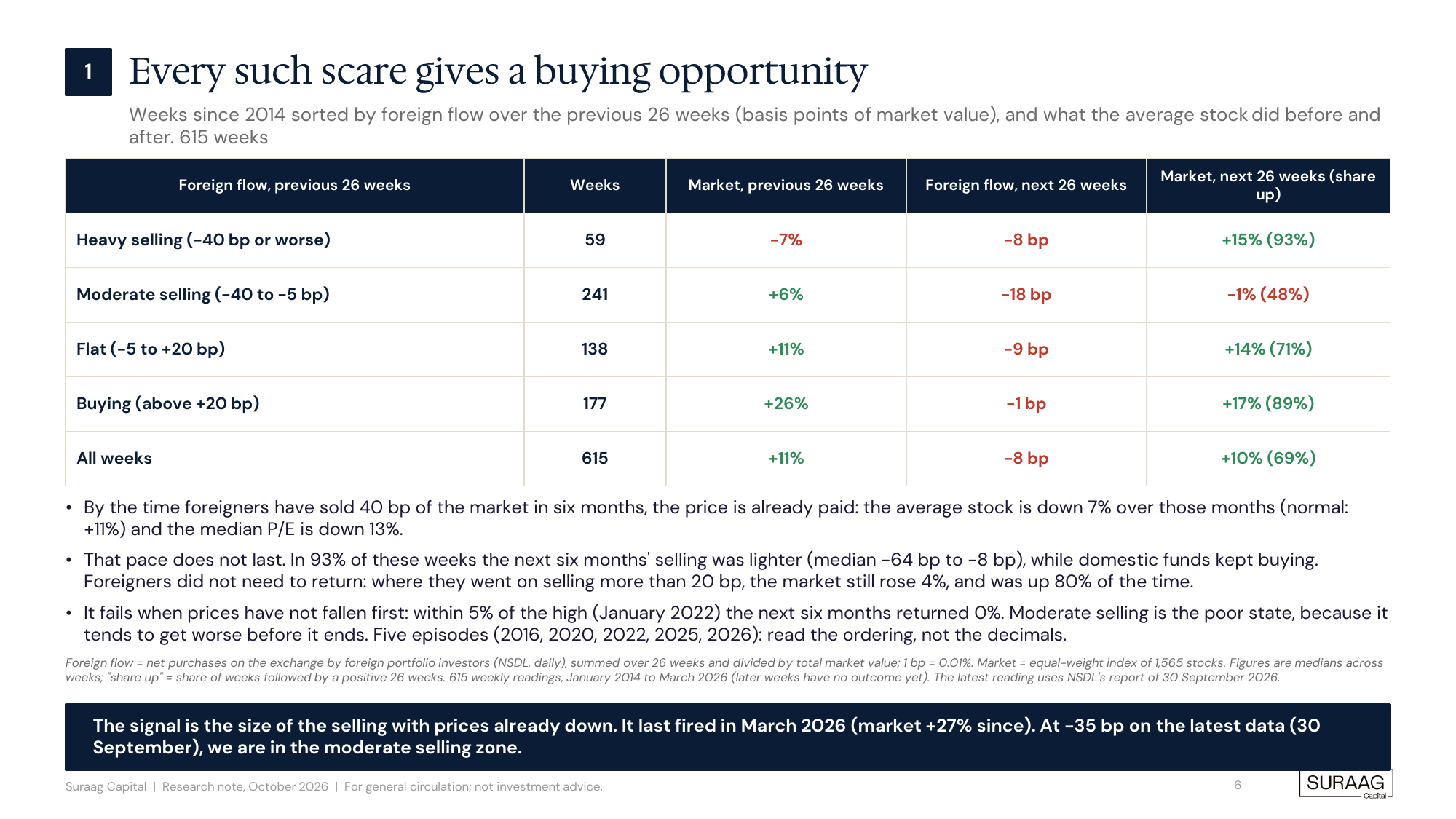
Weeks since 2014 sorted by foreign selling over the previous six months. Page 6 of the research note.
The yield rising today is the "real" half
A US Treasury yield is two numbers added together: the inflation the market expects, and the real return above it.
Expected inflation is where it was five years ago, 2.35% then and 2.35% now. All of the rise in the US 10-year since 2021, 3.7 points, is the real yield. The market is not worried about prices. It wants more return for lending long to a government that borrows $2.1 trillion a year, and it is priced for strong US growth.
That growth rests on one engine. AI-related investment, information-processing equipment, software and R&D, is 8% of the US economy and supplied 47% of last year's growth. It grew 13.4%; the rest of the economy grew 1.3%. Jobs are being added at 41,000 a month, and full-time employment is below where it was in December.
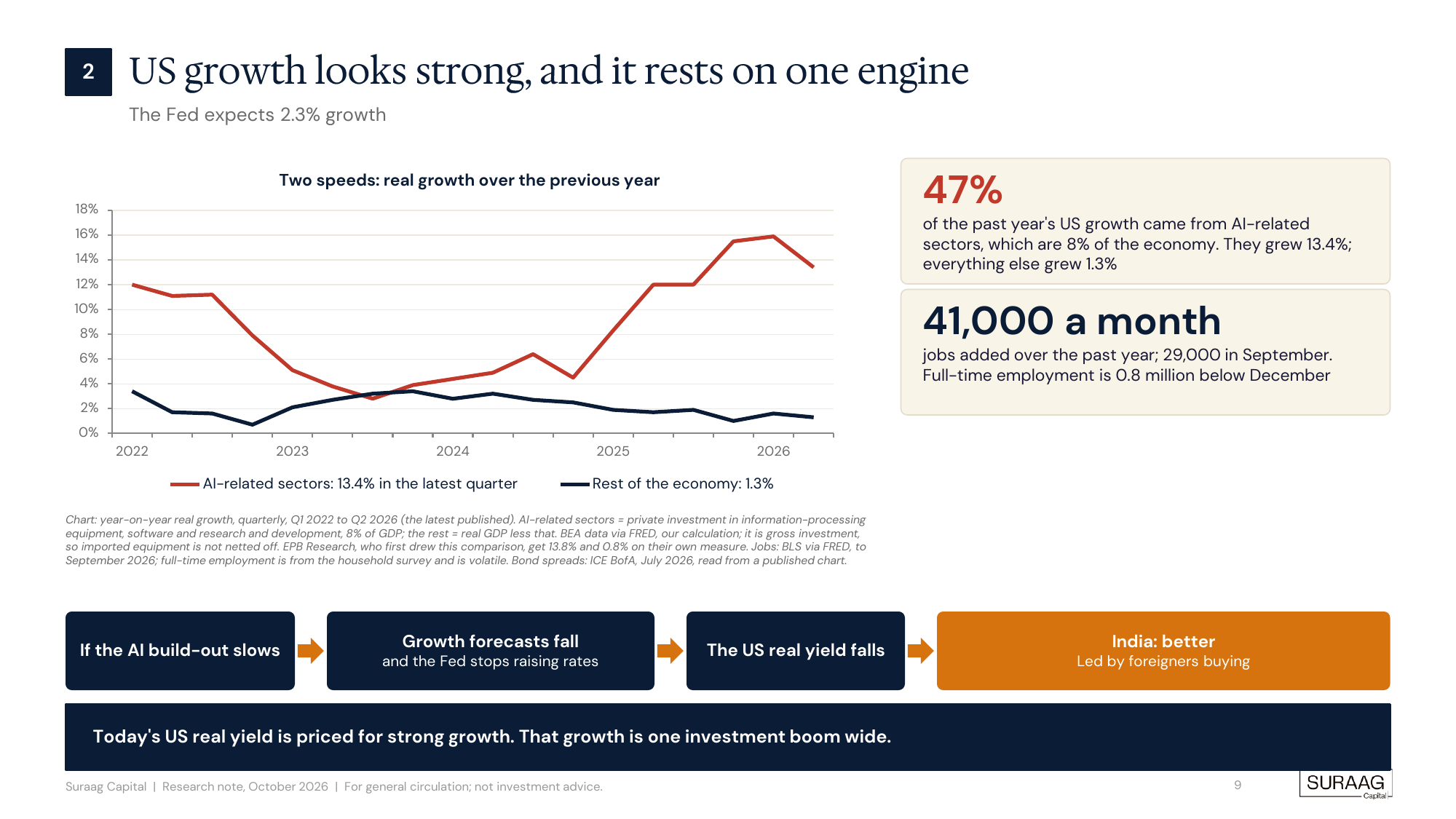
Two speeds: AI-related sectors against the rest of the US economy. Page 9 of the research note.
This matters for India because the two halves of the yield pull the rupee in opposite directions. A real-yield rise lifts the dollar, weakens the rupee and brings foreign selling. That is today's column in the table below. A rise in inflation expectations does the opposite: a softer dollar, foreigners buying, and the scenario in which Indian small caps have historically done best.

Six-month windows sorted by which half of the US yield moved. Page 12 of the research note.
The Fed's Hobson's choice
The Fed holds its short-term rate at 3.88%, while the 10-year has climbed 1.3 points this year to 5.29% with expected inflation flat. The Fed can hold or hike to defend the long end, slowing an economy already strained by expensive home loans and raising the government's own interest bill. Or it can cut to support growth, and watch lenders add inflation and term premium to long-term rates.
Either way, the road ends in higher US inflation, because inflation is the easiest way to shrink a large debt. That is our view, not a forecast. If it plays out, the same 5.3% Treasury turns from a headwind into the one yield scenario that has favoured Indian small caps.
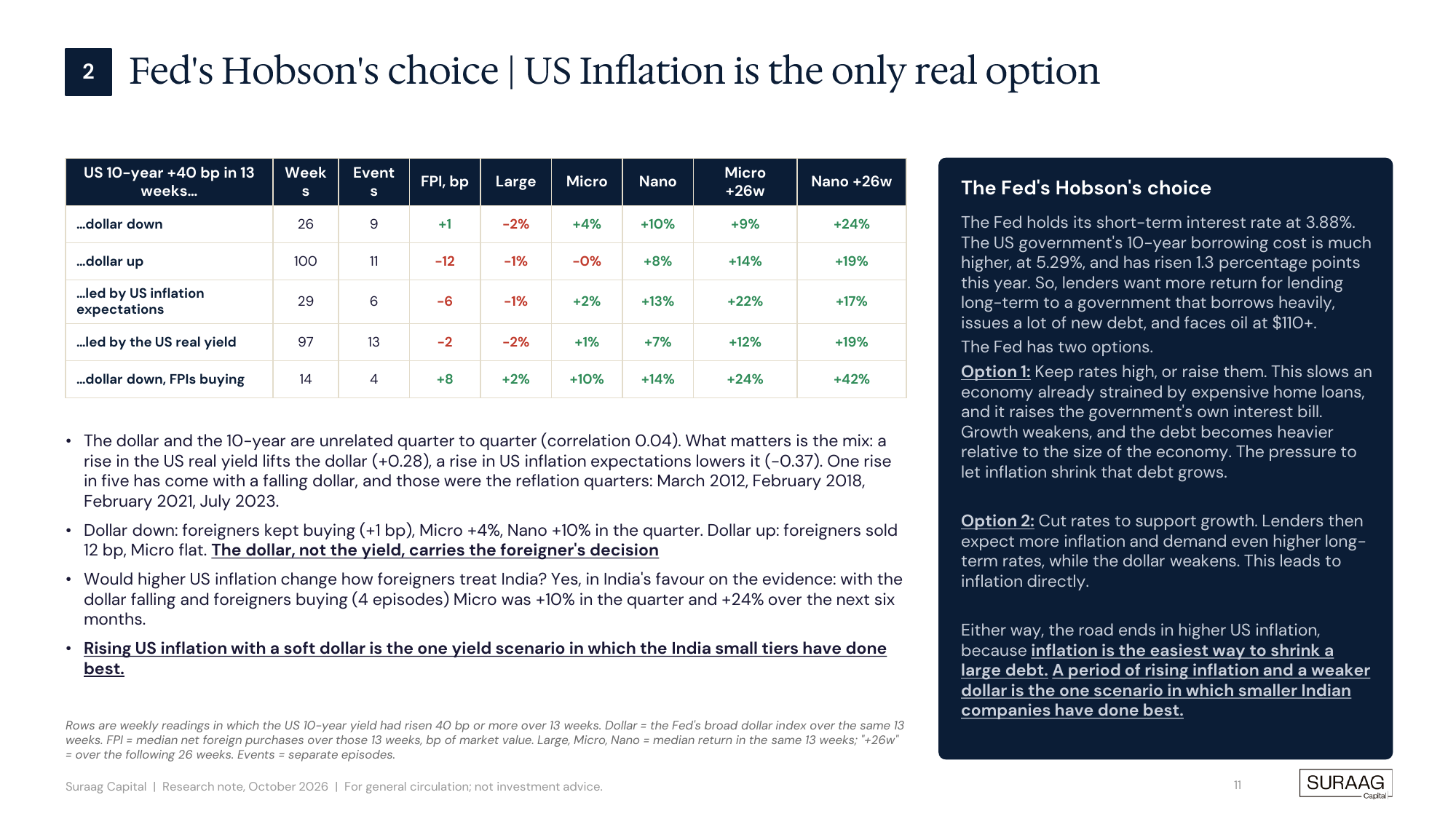
The Fed's two options, and where both lead. Page 11 of the research note.
What we take from this
US yields shift the odds for Indian stocks. They do not decide the outcome. The rupee is the transmission, and today it is steady.
For us, the work stays the same. Nothing trumps bottom-up stock picking and strong fundamental research. We own a small number of businesses we understand, bought at prices we believe are attractive, and we let the macro set the weather rather than the destination.
Download the full research note (PDF)
This is a research note for general circulation, not investment advice. Data to 30 September 2026, prices to 1 October. Definitions, sources and sample sizes are in the footnotes of each page of the note.

©2025 Suraag Capital. All rights reserved.
