

Brands, Habits & Gross Margins: A Few Reflections
A Brand is Just a Promise
Ever wondered what a brand really is?
To me, a brand is just a promise. It tells the consumer, “Here’s what you’ll get from me, every single time.” And when that promise is kept, over and over again, something interesting happens: trust builds. A pattern forms.
Coca-Cola is associated with people being happy around the world. Everyplace Disneyland, the World Cup, the Olympics where people are happy. Happiness and Coke go together"
- Warren Buffett1
Predictability Turns into Habit
When people know what to expect, they stop thinking. The decision becomes automatic and that’s how habits are formed.
And habits are powerful. Research shows that nearly 40% of what we do every day is out of habit, no conscious thought involved2,just routines on autopilot. This is the Holy-grail. In business, habits mean retention. And retention means you’ve likely built something defensible.
Put simply: Brand -> Predictability-> Habits -> Retention -> Moat
During my time in venture capital, I saw this play out repeatedly. Retention is what makes or breaks a business. Overtime, it reduces the need to “spend to grow”, because you only need to acquire new users and not pay to retain the old ones.
Note: In high-retention businesses, marketing spend should be viewed as a P&L investment equivalent to Capex, not an expense. Like Capex, it drives long-term value by acquiring customers with high LTV. Since such businesses often spend in waves or campaigns, a single-year P&L can often be misleading. Instead, investors should focus on unit economics (LTV/CAC) over multi-year periods.
I’ve seen cases where investors cheered sudden profitability after a pullback in marketing only to watch cash burn return once the spending resumed to maintain the user base. The reverse is also true. These dynamics often lead to mispricing opportunities in public markets.
Predictability Turns into Addiction or Network effect (Chain reaction)
Once a customer starts using a product without thinking day-in and day-out, you’ve got something special. That’s retention. This is like brushing teeth or checking email. No reminders needed. No decisions made. Just habit.
But some products go a step further.
1) Addiction- That’s when the customer doesn’t just use your product, they crave more of it. Think caffeine or mobile games. These businesses tap into the pleasure centres and keep pulling the user back for just one more hit.
2) Advocacy- customers become your salesforce without the salary (For example, high-status/mission/cult-driven product)
The above not only retain existing cohort of customers, but also bring in new incremental revenue at negligible incremental marketing spends.
* Special cases which include both-Occasionally, a business captures both. That’s when things really get really interesting. Think smoking or social media apps. These are the businesses that grow like chain reactions.
Businesses built on these tenets (when successful)see runaway growth and take up the market by surprise. They strongly challenge the incumbent.
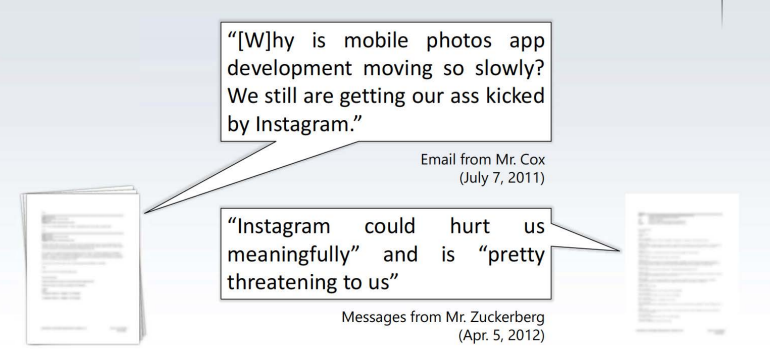
Source: FTC v. Meta (2025),screenshot from FTC’s opening statement.
Meta (Facebook) acquired Instagram for ~$750M in 2012.
Tech crunch in August 2012 reported “While Instagram will certainly help Facebook understand mobile, the lean photo sharing startup won’t have much tocontribute on the mobile monetization side. That’s an area Wall Street and critics have been hammering Facebook over.”
In Summary, businesses built on:
- Habits: maintain consumption from existing user base but need to spend on marketing to acquire new users.
- Addiction: see increasing consumption from existing user base but need to spend on marketing to acquirenew users.
- Advocacy: see new user acquisition without marketing spend.
- Both Advocacy and Addiction together see a runaway acceleration.
Recommended watch: For Maths and Physics enthusiasts, this Veritasium video explains Markov chains and how they model runaway acceleration like nuclear chain reactions.
It’s Not Just About Price. It’s About Effort
Let’s add a different perspective on how low-effort becomes a source of moat.
Consumers (like investors) want a good deal. They want maximum value with least effort. And effort comes in many forms:c ognitive, physical, emotional, monetary and even social. Great deal = Value(-) Effort4.
Great brands make that easy. They remove friction. They become the default choice. And that’s a very hard thing to displace.
Think about it, how many brands in your life do you use out of sheer habit? No comparisons, no second thoughts. Just muscle memory.
Habits + Low Wallet Share = Pricing Power
Now let’s add another layer.
If your product is a small part of someone’s wallet and a habitual purchase, you’re in a sweet spot. Consumers rarely think twice, even if the price goes up a bit. You enjoy customer retention and have price inelasticity. And the gross margins? They likely stay fat. (For example, a chewing gum or a discount brokerage app)
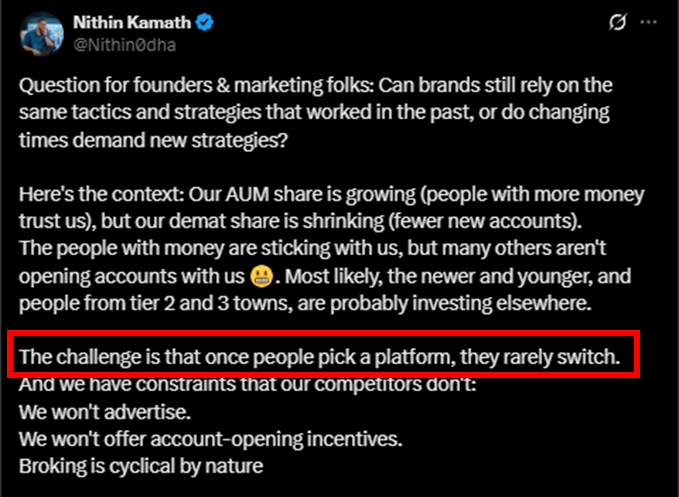
Source: X.com
(Nithin Kamath is the Founder & CEO of Zerodha which had INR 8,320cr i.e.~$1B revenues in FY 24 with 56% PAT margins)
So yes, businesses can follow many templates, some driven by habit, others by addiction, advocacy, low-effort, or low-wallet share. Often, it’s the interplay that creates magic.
At Suraag, we prefer a templatised approach to investing not to simplify the world, but to bring clarity and repeatability to how we seek edges.
We study businesses with quiet obsession. Habits that compound. Margins that hold. And moats that reveal themselves with time.
Sources
1: Warren Buffett, Lecture at the University of Florida School of Business, (October 15th1998)
https://csinvesting.org/wp-content/uploads/2015/01/Buffett_Lecture_Fla_Univ_Sch_of_Business_1998.pdf
2: Habits—A Repeat Performance
https://web.archive.org/web/20110526144503/http:/dornsife.usc.edu/wendywood/research/documents/Neal.Wood.Quinn.2006.pdf

©2025 Suraag Capital. All rights reserved.
